Rooting Hormone: Does It Really Help?
 Reviewed by
 Some swear cuttings won't root without it; others never use it. The honest answer is situational — negligible for easy plants, genuinely helpful for woody, stubborn ones.
Rooting hormone is one of the most over-recommended products in propagation. Some people swear a cutting won't root without it; others never touch the stuff and root everything just fine. So which is it? The honest answer sits in the middle — and depends entirely on what you're propagating.
What rooting hormone is
Rooting hormone is a product containing auxins — plant hormones that naturally trigger root growth. Plants already make their own auxins, which is why cuttings root without any help at all. A rooting product simply adds a concentrated dose at the cut, nudging the process along. It doesn't create roots out of nothing; it encourages a stem that was already capable of rooting to do it a bit faster and more evenly.
The honest answer
For easy plants — pothos, philodendron, tradescantia, most trailing houseplants — rooting hormone makes almost no noticeable difference. They root readily on their own, often in a week, so you're adding a step for little gain. Where it earns its keep is with woody, slow, or stubborn cuttings: fiddle leaf figs, rubber plants, woody herbs and the like. For those, a dab of hormone can improve both the speed and the odds. So it's not a myth and not a miracle — it's a situational tool.
When it helps (and when it doesn't)
| Situation | Worth using? |
|---|---|
| Easy trailing plants (pothos, philodendron) | No real benefit |
| Succulent leaves and offsets | Not needed |
| Woody cuttings (fig, rubber plant) | Yes, can help |
| Air layering woody stems | Yes, often helps |
| Woody herbs (rosemary, lavender) | Yes, can help |
Powder, gel or liquid
All three deliver the same active idea; the format is about convenience. Powder is cheap, long-lasting and the classic choice — you dip the moistened cut end and tap off the excess. Gel clings well and is tidy, good for awkward stems. Liquid concentrates are diluted and the cutting is soaked briefly. For occasional home use, powder is perfectly good and lasts years.
You'll also see natural alternatives suggested — honey, cinnamon, willow water. Honey and cinnamon are really antifungal (they may cut down rot rather than boost rooting), and willow water's rooting effect is mild and inconsistent. They're harmless to try, but don't expect them to outperform a stem that would have rooted anyway.
How to use it
Take a clean cutting
Cut just below a node with clean snips, as normal.
Moisten the cut end
A slightly damp end helps powder stick. For gel or liquid, follow the product's directions.
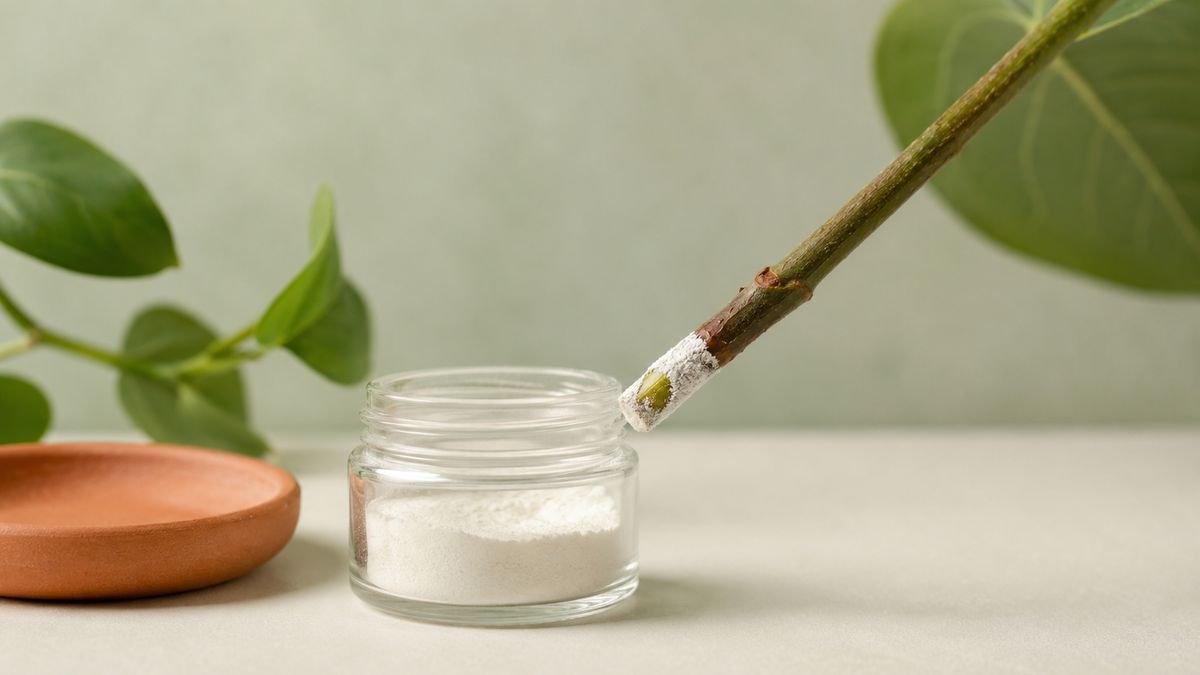
Dip lightly and tap off excess
A thin coating is plenty. Piling on more won't speed anything up and can hinder rooting.
Pot into soil or moss
Hormone works best going straight into a rooting medium like soil or moss, rather than a jar of water where it disperses.
Common questions
Do I need rooting hormone?
Not for easy plants — they root fine without it. It's worth using on woody, slow, or stubborn cuttings, and when air layering, where it can improve speed and success.
Does rooting hormone work in water?
It's designed for soil or moss, where it stays at the cut. In a jar of water it disperses and does little, so save it for medium-based propagation.
Do natural alternatives like honey work?
Honey and cinnamon are mainly antifungal, which may reduce rot rather than boost rooting. Willow water has a mild, inconsistent effect. They're harmless to try but not miracle workers.
Can you use too much rooting hormone?
Yes. A thin coating is ideal; excess can actually hinder rooting. Dip lightly and tap off the extra.